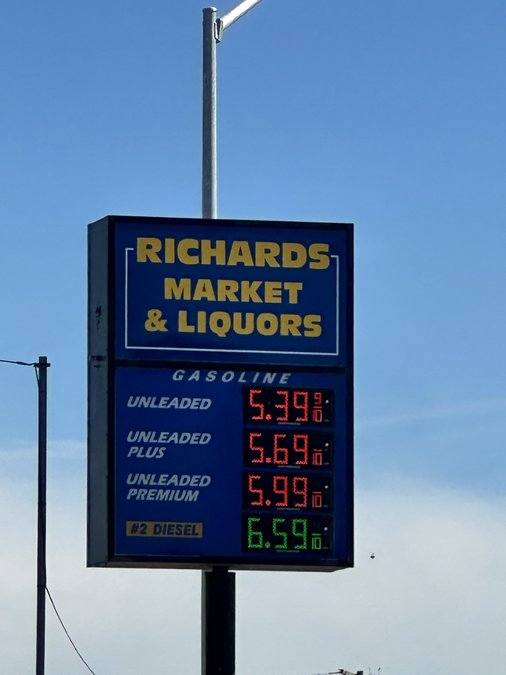
Rising gas prices across California are once again squeezing family budgets, and on the Westside the impact is landing close to home. In communities like Newman and Gustine, where many residents drive daily for work, school, shopping and appointments, the climb at the pump is being felt in quieter but significant ways: fewer extra trips, tighter errand planning and more attention to every dollar spent.
AAA reported California’s average price for regular gasoline at $5.561 per gallon on March 18, compared with the national average of $3.842. The gap underscores how much more California drivers are paying even before local station‑to‑station differences are factored in.
On the Westside, drivers are checking prices more often before they fill up. GasBuddy listings for Newman on March 18 showed regular gas as low as $4.25 at one station and $4.39 at another, a spread that may seem small but adds up quickly for commuters and families filling larger vehicles week after week.
Nationally, the average price of gasoline has risen 24.3 cents over the last week and now stands at $3.92 per gallon, according to GasBuddy data compiled from more than 12 million price reports. The national average is up 98.9 cents from a month ago and 84.1 cents higher than a year ago. Diesel prices have climbed as well, rising 27 cents in the last week to $5.227 per gallon.
Patrick De Haan, head of petroleum analysis at GasBuddy, said seasonal demand, supply concerns and global tensions — including disruptions tied to the Strait of Hormuz — are pushing both gasoline and diesel prices sharply higher. He said the national average could reach $4 per gallon as early as this week, the first time since 2022.
Experts say California’s spike is being driven by several factors. AAA has pointed to stronger spring travel demand, while Reuters has reported that the state’s specialized gasoline blends and limited supply flexibility leave California more vulnerable when global oil markets tighten.
For Newman resident Elena Vargas, the rising cost of gas has turned everyday driving into a budgeting exercise. Vargas, a mother of two who commutes outside town for work, said she now tries to combine errands into one trip instead of making several runs during the week.
“You used to be able to stop at the store after work and not think twice about it,” Vargas said. “Now I plan everything out before I leave the house, because one extra trip here and one extra trip there starts adding up fast.”
Another Newman resident, Carlos Mendez, said the increase is especially frustrating for working families who do not have much flexibility in how often they drive. Getting children to school activities, keeping up with appointments and making regular grocery runs have all become more expensive.
“Gas isn’t something most of us can cut out,” Mendez said. “If you have to get to work, you have to get there. If your kid has practice, you have to take them. It’s one of those bills that keeps rising whether your paycheck does or not.”
In Santa Nella, Dana Ruiz said the family used to fill up without much discussion, but now everyone compares prices, watches the fuel gauge earlier and thinks harder about whether a trip is really necessary.
“We’re not taking random drives, and we’re definitely not waiting until the tank is almost empty anymore,” Ruiz said. “Everybody is paying attention now.”
The same concern can be heard in Gustine. Sabrina Alvarado said the recent jump has made her more careful about when she leaves town and how often she does it.
“It changes the way you think,” Alvarado said. “You start asking yourself, ‘Do I need to go today, or can it wait?’ That’s not how people want to live, but it’s where we are right now.”
In Patterson, Marcus Silva said higher prices have pushed him to think more seriously about ride sharing and public transportation when possible, even though those options do not always fit every schedule.
“You look for any little way to save,” Silva said. “If someone is already heading that direction, maybe you ride with them. If you can combine two things into one trip, you do it. People are adjusting because they have to.”
Transit may offer at least a partial alternative for some residents. The City of Gustine says the community is served by Merced County’s MicroBus by reservation and Stanislaus Regional Transit’s Route 45 West, which connects Gustine, Newman, Crows Landing and Patterson. Those services will not replace the personal vehicle for everyone, but they do provide another option as fuel costs continue to rise.
For much of the Westside, however, driving remains a necessity. Many residents travel across town lines for work, childcare, shopping and medical care, and that dependence makes every swing in gas prices feel immediate.
And the impact goes beyond the pump. Higher fuel prices raise transportation costs for businesses, which can push up the price of groceries, household goods and travel. Delivery trucks, freight carriers and airlines all face higher operating expenses when fuel spikes, and those increases often filter down to consumers. Even local services — from landscaping to mobile repair work — can become more expensive as companies adjust for rising fuel costs.
For Westside drivers, the issue is not simply that gas is expensive. It is that high gas prices ripple through nearly every part of daily life. They shape how families plan their week, how workers get to their jobs and how small‑town residents decide when and where they can afford to go. On the Westside, that pressure is becoming harder to ignore.