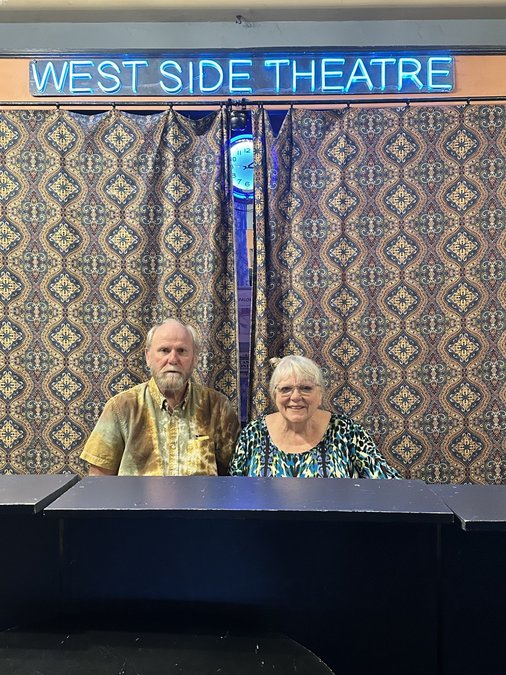
NEWMAN — After three decades of vision, grit, and relentless dedication, Farris and Dave Larsen have retired from running the West Side Theatre, closing a chapter that helped shape the cultural identity of the Westside.
The couple’s journey began in 1991, when a group of local arts enthusiasts formed an arts collective. What started as a dream to create a performing arts venue soon evolved into a full-scale restoration of a long-neglected building in the heart of downtown Newman.
“We are so fortunate to have been able to accomplish our dream and do something magnificent,” said Farris Larsen, “It’s beautiful. Freaking beautiful.”
The theater’s origin story reads like a testament to grassroots determination—and a bit of serendipity. In the early ’90s, the Larsens made an offer on the building, hoping to turn it into a performing arts venue. But another buyer, Hugo Yamamoto, outbid them and converted the space into a Mexican dance hall.
In 1995, Yamamoto stepped away from the property to care for a grandchild following a serious accident. The building went into foreclosure, and that’s when fate—and the city—stepped in.
“James Silvera, who was mayor at the time, called me and said, ‘Farris, we’re back in business,’” she recalled. “He convinced the city council to buy the building, even though there was a lot of controversy. People thought it was a ridiculous investment.”
The city purchased the property for $80,000. What they got was a shell of a structure: no electricity, no plumbing, no stairs, no lights, no chairs, no tables—not even doors. “It was nothing,” Farris said. “But it was ours.”
With the city’s backing and the Larsens’ relentless drive, the West Side Theatre began its transformation from forgotten relic to cultural landmark.
Dave brought carpentry skills, while Farris contributed painting, roofing, and electrical work. Together, they poured thousands of hours into the building’s revival—without contractors, consultants, or a construction crew.
“We did it all ourselves,” Farris said. “To stay in theater and keep our band going, I’ve always done what needed doing—painting, roofing, cement work, tile, electrical, plumbing. That’s how we made it happen.”
One of the earliest fundraising efforts was a chicken barbecue, organized to raise money for basic renovations. “I’d never done one before,” Farris said. “We bought frozen chicken from Foster Farms, sterilized bags, and packed it all into five-gallon buckets. I’m a painter, so we used the bathtub to prep everything. It was wild.”
The event was a community effort. Volunteers picked wildflowers, scrubbed down the rotary booth kitchen, and worked through the night to prepare. “We had flowers on every table, and most of the meals were to-go,” Farris said. “But some people stayed and made it beautiful. The plumbing backed up from washing all that chicken, and we didn’t fix that drain for ten years—we just duct-taped it.”
The barbecue was a success, and the funds raised went directly toward building the theater’s first stage. “You can’t have a theater without a dang stage,” Farris said. “We said, ‘We’re never doing another chicken barbecue, but that money is going to be on that stage.’ And it was.”
Another early event was the Newman Fall Festival Wine and Cheese, a community potluck that drew an unexpectedly large crowd. “We all cooked—my aunt came in from the Bay Area, and I still have the recipes,” Farris said. “Everyone wanted to see the inside of the building, so instead of selling 250 tickets, they accidentally sold 350. It was 110 degrees that day. We brought in these giant fans, but it was still so hot. Let’s just say a lot of people had hangovers the next day at the Fall Festival.”
The first official event in the newly reopened space was the Orestimba High School prom. The city had cleaned up the building just enough to host the dance, and the Larsens took it from there.
“The prom was really the first thing that happened here after the city bought the building,” Dave Larsen said. “Once that was done, we hit the ground running. The first thing we built was the stage—and from there, it just kept growing.”
Soon after, the theater staged its first production: I Remember Mama, performed by the Townsend Opera Players. The Larsens still remember the excitement—and the improvisation—that came with those early days.
“We were so young and so excited,” Farris said. “All we had was our little pickup and a stack of folding chairs we kept under the stage. We measured everything out and set up 400 chairs ourselves. The place was clean, but that was about it. For lighting, we had clamp-on lights mounted to a pole, and Jim was down below plugging and unplugging them by hand. That was our lighting system.”
In its early years, the West Side Theatre stage hosted a mix of local bands, community plays, and grassroots performances. But things truly began to take off when the Larsens booked their first tribute band—a turning point that would shape the theater’s identity for years to come. The tribute shows quickly became a mainstay, drawing packed houses and building a loyal following from across the region.
“Once we brought in the tribute bands, it changed everything,” Dave said. “People started coming from all over. It gave us the momentum to keep going.”
Despite the humble beginnings, the West Side Theatre grew into a vibrant community hub. Over the years, it hosted everything from concerts and film screenings to proms, chamber mixers, weddings, and fundraisers. The Larsens estimate more than 160,000 paid patrons have passed through its doors.
The city of Newman continued to play a vital role in the theater’s success, covering utility bills and providing financial support for renovations. “Without the city of Newman, we couldn’t have done this,” Dave said.
But it was the Larsens’ tireless commitment that kept the theater alive. “It was 200 hours a week, and that is not an exaggeration,” Farris said. Sundays were reserved for cleaning—a ritual she affectionately dubbed “the Church of the West Side Theatre.” She also cooked for volunteers and performers, creating a sense of family that extended beyond the stage.
As they step back, the Larsens have ensured the theater is in good hands. Dave had been managing bookings in recent years, and a dedicated group of volunteers is now poised to carry the torch.
“We have a pretty good group of volunteers right now,” Dave said. “It just felt right because we had people that were very passionate about the theater.”
For Dave, the decision to retire came after years of juggling responsibilities. “I worked at Bonita and ran the theater at the same time,” he said. “Eventually, it just got to be too much. The first time I said I couldn’t do it anymore, they took some duties off my plate. The second time, they took even more. And by the third time, Farris was ready too. She’s 75, and we both agreed—better to walk out with your feet moving than be carried out.”
Their retirement marks the end of an era, but the legacy they leave behind is etched into every beam, spotlight, and memory made within the theater’s walls. The West Side Theatre is more than a building—it’s a testament to what can be built when a community rallies around the arts.
“We are so fortunate,” Farris repeated, her words echoing the sentiment of a town forever changed by their work.