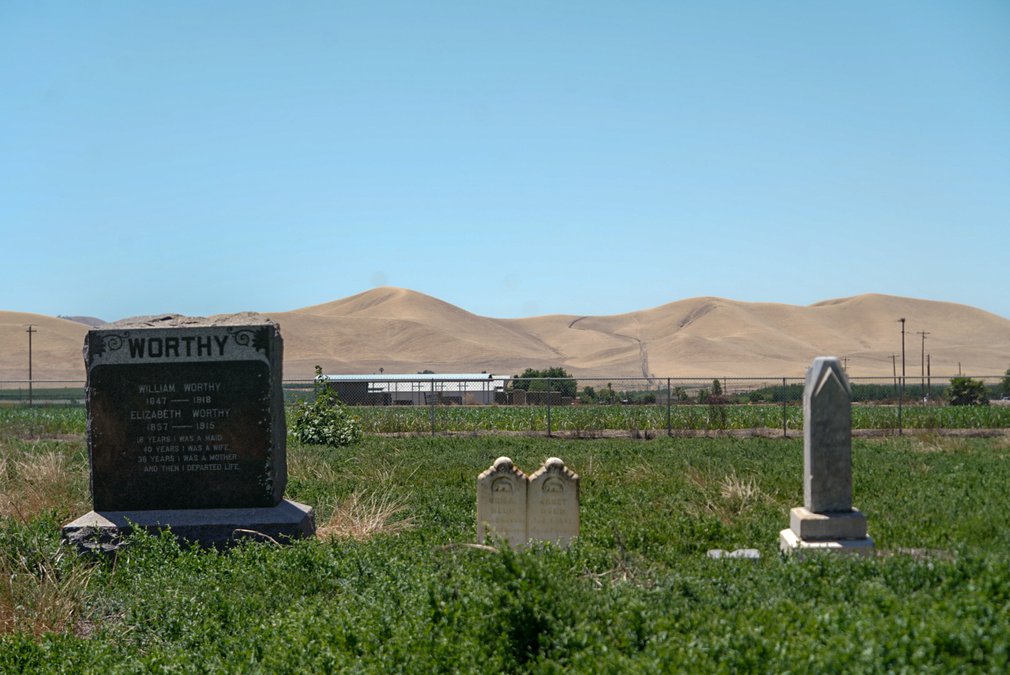
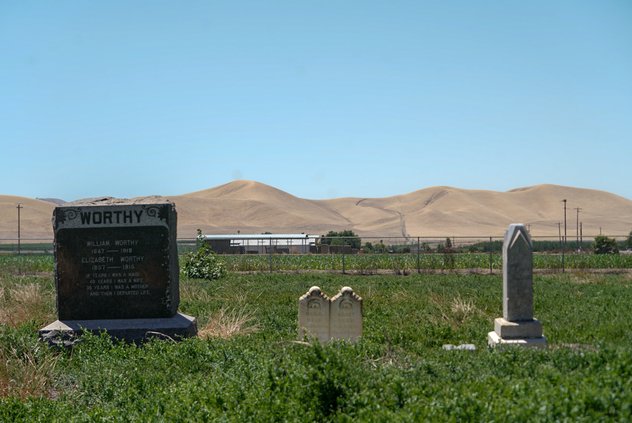
As a high schooler living in Gustine, I spent countless afternoons riding my ATV down Cottonwood Road on the outskirts of town. Every time I passed the quiet stretch of fields and dairies, I felt an unexplained pull toward the chain‑link fence with the wooden sign reading “Cottonwood Cemetery.” What happened here? Why didn’t anyone talk about it? All I could see was an overgrown lot, an unkept tree, a few old headstones and several unmarked graves.
The questions I asked as a teenager sparked my fascination with local history — especially the parts that have been forgotten. In this case, it was a cemetery the county neglected and eventually paved over.
Beneath Cottonwood Road lies the original Cottonwood Cemetery, the burial place of early Gustine settlers and military veterans. An 1888 burial log shows at least 74 people were interred there, including Civil War veterans Henry Bomback and William Daniel Lapp, and Spanish‑American War veteran Thomas Bradley. Only some of those records survived a 1915 fire that destroyed many of Gustine’s earliest documents.
Even former Merced County Assemblyman Andrew Ewing rests there in Lot 153. But instead of a monument or a place of reflection, the site is now a roadway bordered by a fence. The Hills Ferry Cemetery District in Newman assumed responsibility for Cottonwood Cemetery in 1938, but its focus remained on the main Hills Ferry Cemetery, leaving Cottonwood largely ignored.
By the 1950s, Merced County widened and straightened Cottonwood Road, paving directly over unmarked graves. According to accounts from local resident Loretta Kanelos, headstones were pushed into a nearby ditch to make way for the new road.
The story of Cottonwood Cemetery is one of long, quiet neglect. In 2002, Kanelos — a descendant of a pioneer buried there — tried to bring attention to the site. She gathered surviving records and advocated for recognition, but the effort stalled. Since then, another generation has grown up driving over the graves of people like Henry Hicks and Joseph Johns, whose burial records simply say they were laid “in ditch.”
Now, at 20, I realize my generation will decide whether these stories disappear forever or return to the light. We cannot undo the fact that a road was built over our history, but we can stop pretending nothing is there. It is time to give these settlers their names back. It is time to acknowledge that when we drive down Cottonwood Road, we are traveling over the very foundation of Gustine.
Our pioneers deserve more than the sound of tires on asphalt.