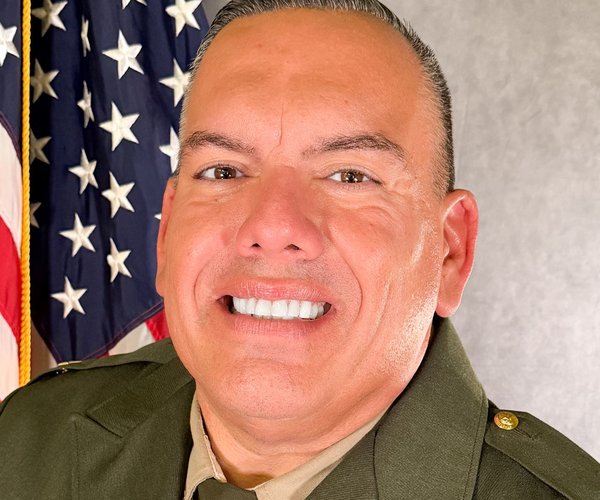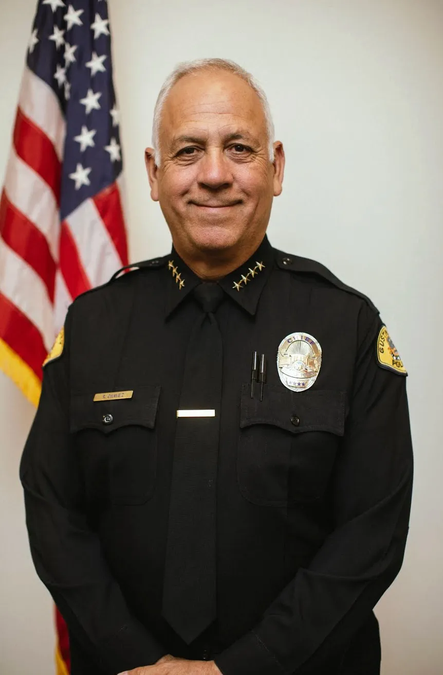
GUSTINE — Police Chief Ruben Chavez, who guided the Gustine Police Department through the COVID‑19 pandemic and built deep ties within the community during more than seven years of service, will retire Jan. 2, 2027, capping a 45‑year career in law enforcement.
The city announced his retirement July 14, noting that Chavez has spent decades in policing across San Jose, Livingston and the Central Valley. His career began in 1982, when he joined the San Jose Police Department as a 21‑year‑old officer. He spent 28 years there before serving two years with the San Jose/Evergreen College District Police Department. In 2012, he became Livingston’s police chief, bringing three decades of experience to the region. He was hired in Gustine in March 2020 — the same week the COVID‑19 pandemic forced widespread shutdowns.
Chavez said those first days in Gustine were unlike anything he had experienced. He recalled how then‑City Manager Doug Dunford, himself a former Gustine police chief, told him his first major assignment was to notify local businesses they had to close under federal orders.
“It was awkward,” Chavez said. “Later I realized how big of an impact it would have on Gustine and how it was a once‑in‑a‑lifetime experience for our nation.”
Chavez said the profession has changed dramatically since he first put on a uniform. When he started, officers didn’t have computers in patrol cars, Tasers, body‑worn cameras or even cellphones.
“I laugh today, but in 1986 I had to borrow a pager from a friend to be notified when my wife went into labor with our first child,” he said. “Today, social media has become the main platform to be notified of everything. YouTube, Facebook, Instagram and Twitter are truly game changers. Who knows what is next with artificial intelligence.”
Ending his career in Gustine, he said, has been one of his greatest honors.
“While we are a small and quiet agency, we have the best employees and volunteers around,” Chavez said. “Their dedication and commitment to serve are as good as they come, even compared with the employees when I worked at the San Jose Police Department.”
He credited Gustine’s officers and staff for maintaining a low crime rate during his tenure, saying their work ethic rivals that of much larger departments.
Chavez said his career was shaped by mentors who encouraged him to pursue leadership training, including earning a master’s degree from San Jose State University and attending the FBI National Academy in Quantico, Virginia. He named Deputy Chief Don Anders, former San Jose Police Chief Chris Moore, Captain Walt Tibbet and Captain Dick Fairhurst as key influences. He also thanked retired Merced Police Chief Norm Andrade and retired CHP Chief Sam Samra for guiding him when he first became a chief.
During his time in Livingston, Chavez earned the James Q. Wilson Excellence in Community Policing Award for a youth program he helped develop with then‑Merced County Mental Health Director Manuel Jimenez. The program, Mental Health and Police in Schools (MAPS), paired a school resource officer with a mental health clinician — a rare approach at the time. The award was presented at the 2016 California Police Chiefs Association training seminar.
“There were some great programs presented, but winning this award with many larger agencies in the competition was truly humbling,” he said.
Chavez also valued his work with the FBI’s Sacramento Field Office, praising Special Agents in Charge Monica Miller, Sean Ragan and Sid Patel as “true professionals.”
His years in Gustine brought memorable moments, including meeting Portuguese President Marcelo Rebelo de Sousa during a visit to the city and traveling with Mayor Pat Nagy to the Azores for a sister‑city ceremony.
“The community has been awesome,” Chavez said. “One highlight was getting to know the Portuguese people and meeting President Marcelo Rebelo de Sousa. Later, traveling to the Azores with Mayor Pat Nagy was amazing. Seeing him represent Gustine at the various ceremonial events was a bonus.”
Chavez said he plans to continue attending the Festas, which he described as a hallmark of Gustine’s close‑knit cultural identity.
He announced his retirement early so he can help mentor his successor and ensure a smooth transition.
Asked what he plans to do next, Chavez said he looks forward to spending more time with his family, especially his grandchildren. He also plans to stay involved in Civil War reenactments and continue playing drums with the San Jose Police Emerald Society Pipe and Drum Band. Honoring fallen officers, he said, remains deeply important to him, and he intends to continue traveling to Washington, D.C., for Police Memorial Week each year.
He and his wife also hope to travel widely, including trips to support missionaries connected to his Christian faith.
“My wife and I want to experience the wonders that our good Lord has provided for us,” he said. “I have been so blessed to have worked in Gustine for the last seven years. It has truly been an honor.”