For generations of California travelers, a steaming bowl of split pea soup has been more than a meal—it has been a ritual. A marker on the map. A comforting pause between long stretches of highway. And now that ritual lives in only one place: Santa Nella, California. With the closure of the original Buellton restaurant in 2024 and demolition inching closer this year, the Santa Nella location has become the sole remaining Pea Soup Andersen’s, carrying the full weight of a century‑old legacy on its ladle.
The restaurant’s story began on June 13, 1924, when Danish immigrants Anton and Juliette Andersen opened Andersen’s Electric Café along Highway 101. Their vision was simple: serve wholesome, homemade food to travelers. Juliette’s split pea soup quickly became the standout dish, so popular that within three years the Andersens were ordering one ton of peas to meet demand. As the historical record notes, “When Anton faced the problem of what to do with one ton of peas, he solved it by putting them in the window, proclaiming the restaurant, ‘The Home of Split Pea Soup.’” That slogan remains unchanged a century later.
The Buellton restaurant grew into a full hotel and dining room, attracting celebrities, journalists, and families who planned their trips around a stop for soup. It became famous for its Danish‑style architecture, its cartoon mascots Hap‑pea and Pea‑wee, and its reputation as a quintessential California roadside landmark. But while Buellton built the brand, Santa Nella would eventually become its future.
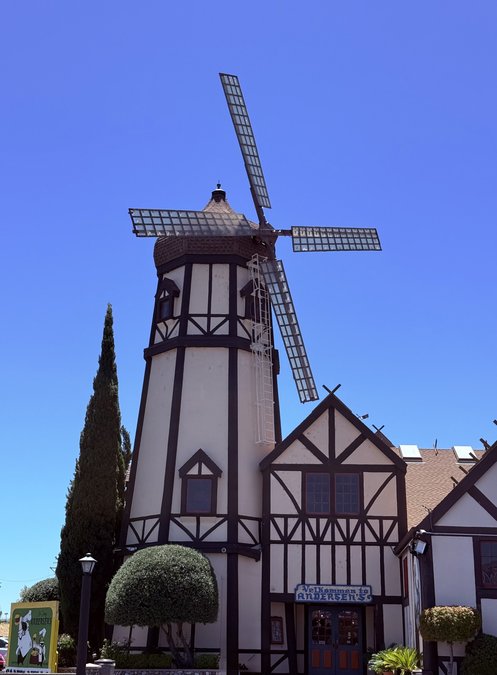
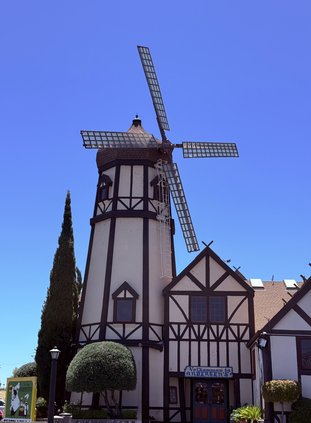
The Santa Nella location opened on December 6, 1976, the vision of owner Vince Evans, who wanted to create a new “service town” along Interstate 5. He built a restaurant, hotel, gift shop, and service station, all featuring Andersen’s signature Danish charm. To make the site unforgettable, he added a 77‑foot working windmill—the first of its kind in California—which still turns whenever the restaurant is open. The building’s 18,000 square feet include multiple dining rooms that seat up to 450 people, plus a banquet room upstairs that can accommodate 200. Opening day drew more than 10,000 customers, and more than 60,000 visited in the first month alone .
Today, Santa Nella’s Andersen’s is not just surviving—it is thriving. Restaurant Manager Armando Hurtado sees firsthand why the landmark continues to resonate with travelers and locals alike. “The comments that I hear from most of my customers is, ‘I used to come here with my grandparents and parents,’” Hurtado said. That multigenerational bond is the restaurant’s heartbeat. Families return not only for the soup, but for the nostalgia, the warmth, and the sense of continuity that has defined Andersen’s for 100 years.
Inside, the restaurant feels like a living time capsule. The décor, the mascots, the gift shop, and the familiar menu all echo the original Andersen vision. Even the feats of loyal customers have become part of the lore—the current record for competitive eating stands at an astonishing 19 bowls of split pea soup in one sitting.
But Santa Nella’s Andersen’s is more than a roadside attraction. It has become a vital part of the Westside community. Under Hurtado’s leadership, the restaurant makes annual donations to the local fire department, provides food and resources to underserved families in nearby Los Banos, hosts the beloved “Breakfast with Santa” event at Romero Elementary School, and collaborates regularly with the Westside Auto Club. Its banquet rooms have become a gathering place for regional organizations, including the Gustine‑Newman Garden Club, and a meaningful venue for families hosting celebrations of life.
The restaurant’s staying power is rooted in the same philosophy introduced by Anton and Juliette in 1924: every meal is prepared fresh daily, every entrée is homemade, and every guest is treated like family. Even though the restaurant sells bags of split peas with Juliette’s recipe printed on them, many customers insist their home versions never taste quite the same. As the historical account puts it, “Perhaps it's the magical touch that Juliette lent to the cauldrons and ladles so many years ago!”
While Santa Nella continues to thrive, the Buellton location—once the flagship of the Andersen empire—faces a far different future. After nearly a century in business, the restaurant closed in January 2024. The building, a designated historic landmark, is now under consideration for demolition. During a March 26 meeting, the Buellton City Council rejected a proposal to relocate part of the structure, citing design conflicts with the Avenue of Flags’ mandated Art Deco style and concerns about the building’s structural integrity. Officials noted that the level of retrofitting required “would effectively result in a new structure rather than preserving the original.”
Instead, the city is exploring ways to preserve select historical elements, including stained glass windows, interior railings, and a large wooden artwork featuring Hap‑pea and Pea‑wee. Artifacts from a museum once housed at the site have already been recovered and placed in storage. A historical resources report is pending, and the demolition permit process could take three to six months.
With Buellton shuttered, Santa Nella’s location—once one of several Andersen’s restaurants statewide—has become the final keeper of the brand’s legacy. Other locations in Selma, Mammoth Lakes, and Carlsbad closed long ago. Santa Nella survived because of its strategic placement along I‑5, where steady freeway traffic has sustained business even as tourism patterns shifted elsewhere.
Today, Pea Soup Andersen’s is owned by Central Coast restaurateur Milt Guggia, who purchased the Buellton location in 1999 and Santa Nella in 2007. Guggia grew up visiting Andersen’s with his grandparents and has made it his mission to preserve the restaurant’s family warmth and traditions. Under his leadership, and with Hurtado guiding daily operations, the Santa Nella location continues to honor the Andersen legacy while welcoming new generations of travelers.
For readers in the 209 region, the significance is clear. Santa Nella’s Andersen’s is no longer just a familiar stop on the way to Los Angeles or Sacramento. It is the last place where the original recipe, the Danish architecture, the windmill, the mascots, and the nostalgia still live. It is the final chapter of a story that began with a tiny café, an electric stove, and a bowl of soup that captured the imagination of the world.
And as Hurtado sees it, that story is far from finished. “Every guest is treated like family,” he said. “That’s what keeps people coming back.”
In Santa Nella, the Andersen legacy endures—one bowl at a time.