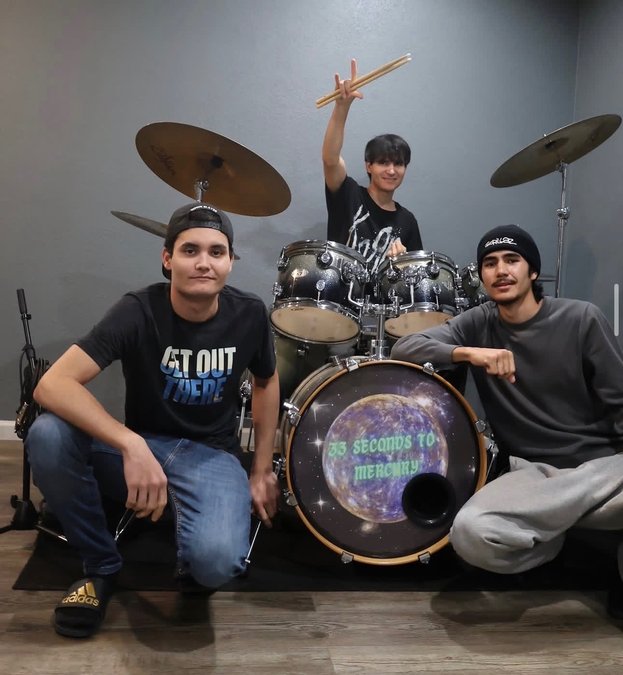
For the Yanez brothers in Gustine, 33 Seconds to Mercury is more than a band — it is a family project rooted in childhood memories, years of practice and a shared love of rock music.
The trio includes Armand Yanez on guitar and lead vocals, Aaron Yanez on drums, and Brandon Yanez on bass and backup vocals. They have been performing together for about three years, but their connection to music began long before they officially formed a band.
Armand said he first picked up a guitar at age 7 after his father bought him instructional DVDs. “My dad would buy me DVDs that teach people how to play the guitar, and I kept practicing for the next few years,” he said. Around 2022 or 2023, their father encouraged the brothers to take their music further. “Our dad asked us, ‘Hey, why not start a band?’”
Armand and Aaron initially searched for a bass player, but their younger brother stepped in. “Our youngest brother, Brandon, decided to become our bass player and jumped right into the band,” Armand said.
Brandon said the band originally started with Armand on guitar and Aaron on drums. At the time, he was still a child and unsure of what instrument he wanted to play. “I was 5 years old at that time, so I didn’t know what instrument to play until I turned 17 and my brothers were looking for a bass player,” he said. “That’s when I jumped in and started playing bass.”
Growing up around music helped inspire him. “Seeing my brothers play songs I grew up listening to and hearing songs on the radio with my family inspired me to start a band with my brothers,” he said.
Aaron’s musical beginnings were just as early. Before he had a drum set, he was already pretending to be a drummer. “I remember when I was 4 or 5 years old when I used to play with my mom’s pots and pans with some wooden spoons and pretended to be a drummer,” he said. When he was 6, his father bought him a drum set and DVDs to help him learn. “I learned slow but steady,” he said. “I really enjoyed it.”
As the brothers grew older, their music grew with them. What began as cover songs evolved into original music and a style of their own. Brandon said the experience has taught him how to create and produce music, as well as how to connect with audiences. “The biggest lessons I’ve learned are how to talk to the audience, produce music and make music,” he said.
Armand said learning guitar was challenging when he was younger, but practice helped him build confidence. “When I was a kid, it was a challenge for me, but I got used to it when I got older,” he said. “Now, I can learn any kind of rock covers and I can make my own songs.” He said one of the biggest lessons he has learned is the value of consistent practice. “The more I work on my hands, the faster and stronger they’ll be.”
Aaron said he learned to keep practicing even without a perfect setup. When the band shifted from covers to original music, he had to find his own rhythm. “At first, I didn’t know where to start, but looking at other drummers and my teachers from the DVDs, I became creative and just went with it,” he said. “Even if there wasn’t a place for me to practice playing drums, I still used objects, like pillows, and watched my teachers on the DVDs to continue practicing.”
The brothers’ sound is shaped by the rock bands they grew up listening to. Brandon said his influences include Black Sabbath, AC/DC, Green Day, Muse and Dio. Armand said he draws inspiration from AC/DC, Muse, Green Day, Led Zeppelin, Black Sabbath and Dio. Aaron’s influences include Black Sabbath, Deep Purple, Dio, Green Day, Korn, System of a Down, Led Zeppelin and Linkin Park.
Looking ahead, the brothers hope 33 Seconds to Mercury continues to grow. Brandon said he dreams of performing on larger stages and hopes listeners feel the emotion behind their music. “The message I want the people to capture is that when they hear our music they feel our emotions of how much we put on the songs and our thoughts,” he said.
Armand said he hopes more people discover their music. “I want people to feel happy and enjoy our music,” he said.
Aaron said he wants the band to keep creating and reach listeners beyond their local performances. “My hopes for the future of the band are to make more music to get people to recognize us in different places, especially on Spotify and on other music platforms,” he said.
For 33 Seconds to Mercury, the music is still growing, but the heart of the band is already clear — three brothers learning together, practicing through challenges and turning the rock music they grew up loving into songs of their own.