NEWMAN — Local, state and federal water officials gathered in Newman last week to celebrate the completion of the Orestimba Creek Recharge and Recovery Project, a major groundwater initiative designed to boost water reliability, improve flood management and strengthen drought resilience across the Westside.
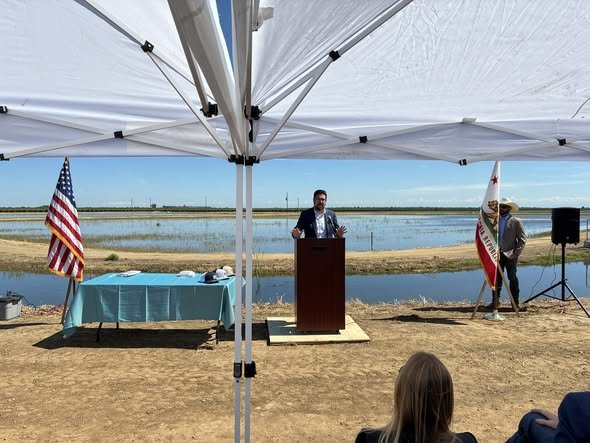
The ribbon‑cutting ceremony was held April 14 at the project site on Orestimba Road, hosted by the Del Puerto Water District and the Central California Irrigation District. The event featured remarks from elected officials, agency leaders and community partners, followed by a luncheon at Stewart & Jasper Orchards.
The celebration marked the end of a multi‑year effort to expand and modernize groundwater recharge capacity along Orestimba Creek. The State Water Resources Control Board awarded $5.6 million through its Proposition 1 Stormwater Grant Program to fully fund construction of the project’s recharge ponds and conveyance structures, and in 2023 issued a five‑year temporary groundwater recharge permit to help maximize stormwater capture during wet seasons.
“This project strengthens water security and mitigates flood risks for the region,” said State Water Board Chair E. Joaquin Esquivel. “I congratulate the districts on their partnership and their commitment to making critical investments in water resilience.”
The project expands an existing 20‑acre recharge site to nearly 80 acres. It captures and diverts excess surface water and storm flows from the Delta‑Mendota Canal and directs them into percolation ponds along Orestimba Creek. The water then infiltrates into the underlying Delta‑Mendota Subbasin, where it can be recovered in dry years to support agriculture and reduce pressure on groundwater pumping.
“Reaching this milestone is exciting, but my reflections go first to the importance of collaboration and partnerships,” said Anthea Hansen, general manager of the Del Puerto Water District at the groundbreaking ceremony in 2023. “This locally owned groundwater storage is a first for the Del Puerto District and its landowners, and I hope we can use what we learned as a model for future projects in the region.”
The project includes new pipelines, a turnout from Orestimba Creek, use of existing Delta‑Mendota Canal turnouts, and construction of up to eight recovery wells capable of supplying water during two consecutive critical years. Provost & Pritchard assisted with design, permitting and environmental compliance.
The San Joaquin River Exchange Contractors Water Authority has identified long‑term goals of developing 50,000 acre‑feet of storage and 500 cubic feet per second of peaking capacity to help avoid shortages during critical years and reduce reliance on the San Joaquin River. Studies have shown the Orestimba Creek alluvial fan has strong recharge potential, making the site a key component of regional water‑supply planning.
Funding for the project comes from multiple sources, including the State Water Board’s $5.6 million stormwater grant, $800,000 from the Department of Water Resources’ Integrated Regional Water Management Program, $1 million from the Bipartisan Infrastructure Law, and contributions of $1.5 million from CCID and $1 million from Del Puerto Water District for land acquisition and construction.
The project aligns with statewide goals outlined in Gov. Gavin Newsom’s Water Supply Strategy, which calls for expanded stormwater capture, groundwater recharge, wastewater recycling and storage to offset an anticipated 10% loss in California’s water supplies by 2040 due to climate change.