For Chloe Martin, the work of a school librarian begins with books, but it certainly does not end there.
As Gustine Unified School District’s teacher librarian, Martin’s days can include recommending books, helping teachers with lessons, teaching research skills, organizing reading challenges and finding creative ways to show students that reading can be something they enjoy.
Her path to the library grew naturally from her years in the classroom. “As a classroom teacher, I have loved watching my students turn into readers,” Martin said. “If you ask any of my past students, or their parents, we read a lot in class.”
Building a culture around reading allowed her to watch students find themselves in characters, make connections across subjects, build empathy and, sometimes most importantly, finally find the book or series that caught their attention. When Gustine Unified began investing more heavily in its libraries, Martin enrolled in a library and information science program to earn the qualifications needed for the position. “It felt like a naturally good fit for me and combined my favorite things: reading and working with kids,” she said.
Her connection to students extends well beyond a single school year. Living in Gustine and working at each of the district’s school sites has allowed her to watch many of the same children grow from elementary students into young adults. “What is most fulfilling to me is watching my students go from babies in elementary school to the most impressive young adults,” Martin said. “Living in Gustine and working at each of our school sites has allowed me to see the wonderful people my students grow into and watch them take on the world.”
While many people picture a school librarian sitting behind a desk and checking out books, Martin said much of the job happens where people never see it. Keeping a school library current means following literature reviews, identifying gaps in the collection, repairing books and helping teachers find materials that complement classroom learning. “And that’s just the book end of things,” she said.
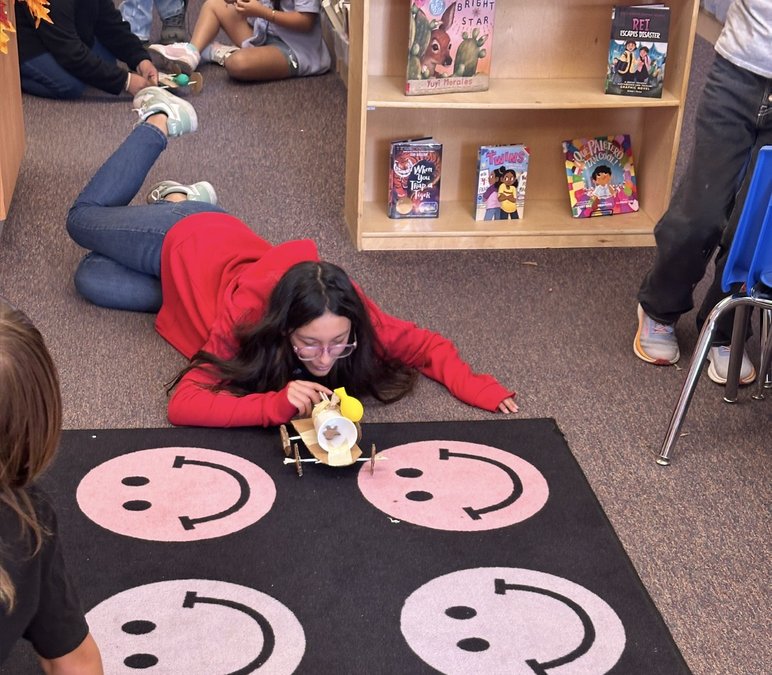
A large part of her work involves collaborating with teachers. She co-teaches lessons, assists with enrichment and remediation, and helps students develop research skills. If she has an open period, she often heads into a classroom or invites a class into the library. She also spends time creating activities, games, reading challenges and after-school programs that make the library a place students want to visit. “The strongest case for a school librarian is not that the library does one isolated thing well,” Martin said. “It is that the librarian connects people, instruction, resources, reading and inquiry across the school and, with a good team, across the district.”
One challenge is reaching children who have already decided they are not readers. Keeping shelves stocked with current, high-interest books is one way to change that. Martin regularly rotates displays and gives “book talks” during library visits to introduce students to stories they may otherwise walk past.
She also gives students permission to stop reading a book they do not like. Martin tells them that avid readers often have two lists: a TBR, or “to be read” list, and a DNF, or “did not finish” list. Finding the right book sometimes requires putting down the wrong one first. She also pushes back on the idea that graphic novels, picture books or other formats somehow do not count. “To me, that is bogus,” she said. “I find that allowing kids to read a book of their choosing, purely for pleasure, makes it easier to get kids engaging with reading. All reading is real reading!”
Once a student finds the right book, she has seen how quickly things can change. Martin recalled working with one student who simply could not find anything he wanted to read. They tried different genres and formats until he discovered Mac Barnett’s Mac B., Kid Spy series. “Once we discovered that he was an action fan, it was game over,” she said. The student finished the entire series and moved on to the InvestiGators books. “Last year, he did not identify as a reader, but this year he knows he is an adventure book guy,” Martin said. “I love that for him!”
Another memorable moment came while she was teaching second graders how to conduct research using the PebbleGo database. One class became so interested that students began researching topic after topic, from feudalism to Neil Armstrong. Their teacher eventually turned PebbleGo research into an early-finisher activity because students kept asking to use it. “How many second graders do you know who BEG to use a database for research?” Martin said. “Before this, I would have said none.”
Those moments, she said, show that libraries are not only about encouraging children to read stories. They help students become curious, learn how to ask questions and determine where to find reliable information. Martin encourages families to make reading part of everyday life as well, suggesting about 20 minutes of reading each day. “At first it may seem impossible,” she said. “But just like anything else worth doing, it gets easier and better with time. It is like going to the gym, but for your brain!”
The work taking place in Gustine comes as school libraries across California continue to face wide differences in staffing and resources. California’s Model School Library Standards call for a credentialed teacher librarian at a ratio of one full-time position for every 785 students, along with classified paraprofessional support. State data also show substantial differences in staffing among California school libraries.
Gustine Unified has made additional library staffing and access part of its recent investment in literacy. District planning documents include a full-time credentialed teacher librarian and media clerks to expand library access, instructional support, digital literacy, independent reading and research opportunities.
Martin believes having someone physically present in the schools makes a difference because it allows a librarian to build relationships with students and teachers and respond to what they need throughout the day. “In my opinion, this is an equity issue,” she said. “Our students deserve the same access to library services as those in larger districts do.” She hopes families who value the changes taking place in Gustine’s libraries will continue making their voices heard and supporting the programs.
For Martin, however, perhaps the strongest argument for school libraries is not found in a report or staffing ratio. It can be found in the child who once said he was not a reader and now knows exactly which shelf he wants to visit, or in a classroom of second graders asking if they can spend their free time researching.
Those small moments are why she wanted to become a teacher librarian in the first place. Sometimes creating a reader is not about convincing a child to love books. It is simply about helping that child find the one book that opens the door.